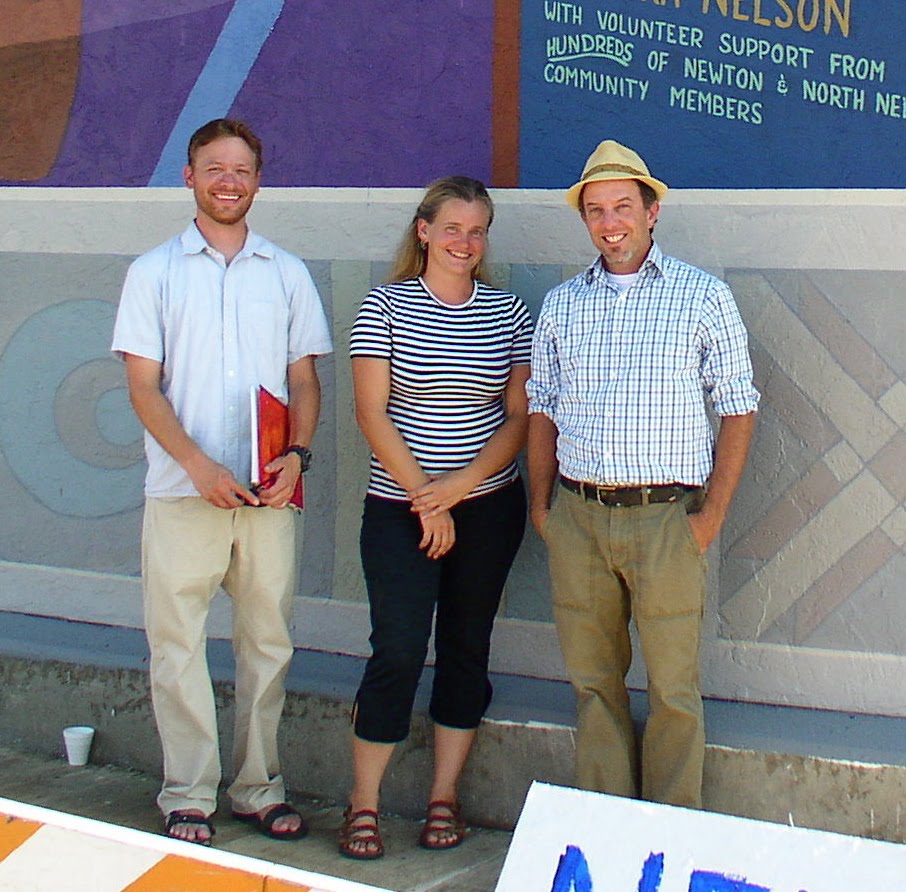
Loewenstein describes his mural process as "part street instillation, part performance piece, and part social intervention." Local participants — often in smaller, rural communities — are involved in every step of the process. He engages directly and openly with the townspeople, translating their thoughts into images, their actions into dance.
Loewenstein has completed 75 murals across the nation, and one in Northern Ireland. His mural-making schedule for 2011 is booked solid. Yet he finds time to produce countless editions of his often politically charged stencil prints and posters (included in four published anthologies of activist art in the past two years), and to serve on the board of the Lawrence Percolator, "a place where artists and audiences can interact comfortably," of which he is a founding member.
And there's more. This spring, Loewenstein takes his art off the street and into the halls of academia, teaching a class called "Roots and Practices: Community-Based Public Art" at Washburn University in Topeka. He is also an accomplished writer: Blank Canvas, his now-retired blog on Lawrence.com, took the Kansas Press Association's 1st Place Columnist award in 2007. He is the co-author, with Lawrence artist Lora Jost, of Kansas Murals: A Traveler's Guide, now in its second edition from University Press of Kansas. Discussing topics for this interview, Loewenstein winces at the term "community art."
______
Tom King: What's wrong with saying 'community art?'
Dave Loewenstein: I don't like how it's characterized sometimes. It puts me in a box. People figure they know what it is: simple, pedestrian — not 'Art.' Anytime you collaborate with so-called non-artists and passers-by, many people in the 'Art' community belittle it: 'Oh, it's just kids painting murals, just paint slapped on a wall.'
TK: What is it, then?
DL: Murals are part of it, of course; murals are the focus. The art really matters. But for me, where the mural used to be the end goal, now the scope is much broader. The mural process is an opportunity to engage people to manifest something they couldn't do on their own. Murals are what get me in the door, because people understand that idea. But then we get going on other things that can happen, and suddenly you've got a roomful of disparate people having a conversation about making something. Then things really get interesting.

Dave Loewenstein, detail of "The Imagineers," in Newton, Kansas, completed in September 2010. Image: courtesy of the artist
For example: the last mural we did, The Imagineers, was in Newton, Kansas, in the Salvation Army parking lot where kids would hang out and drink beer on weekends. We moved in, working day and night, and the kids got interested. We started showing movies on the wall at night, and pretty soon most of town came to visit.Sara Dick, one of our design team members, stopped by. She was back from a Liz Lerman dance workshop in Washington and was eager to choreograph something in the Lerman mode. She took note of what was going on, all the people from all walks of life. She organized everyone, and, at the mural dedication ceremony, premiered a dance she choreographed based on the parking lot scene — the locals were the dancers.* But the great thing was, as soon as the dance was over, people were asking, 'When's the next one?'
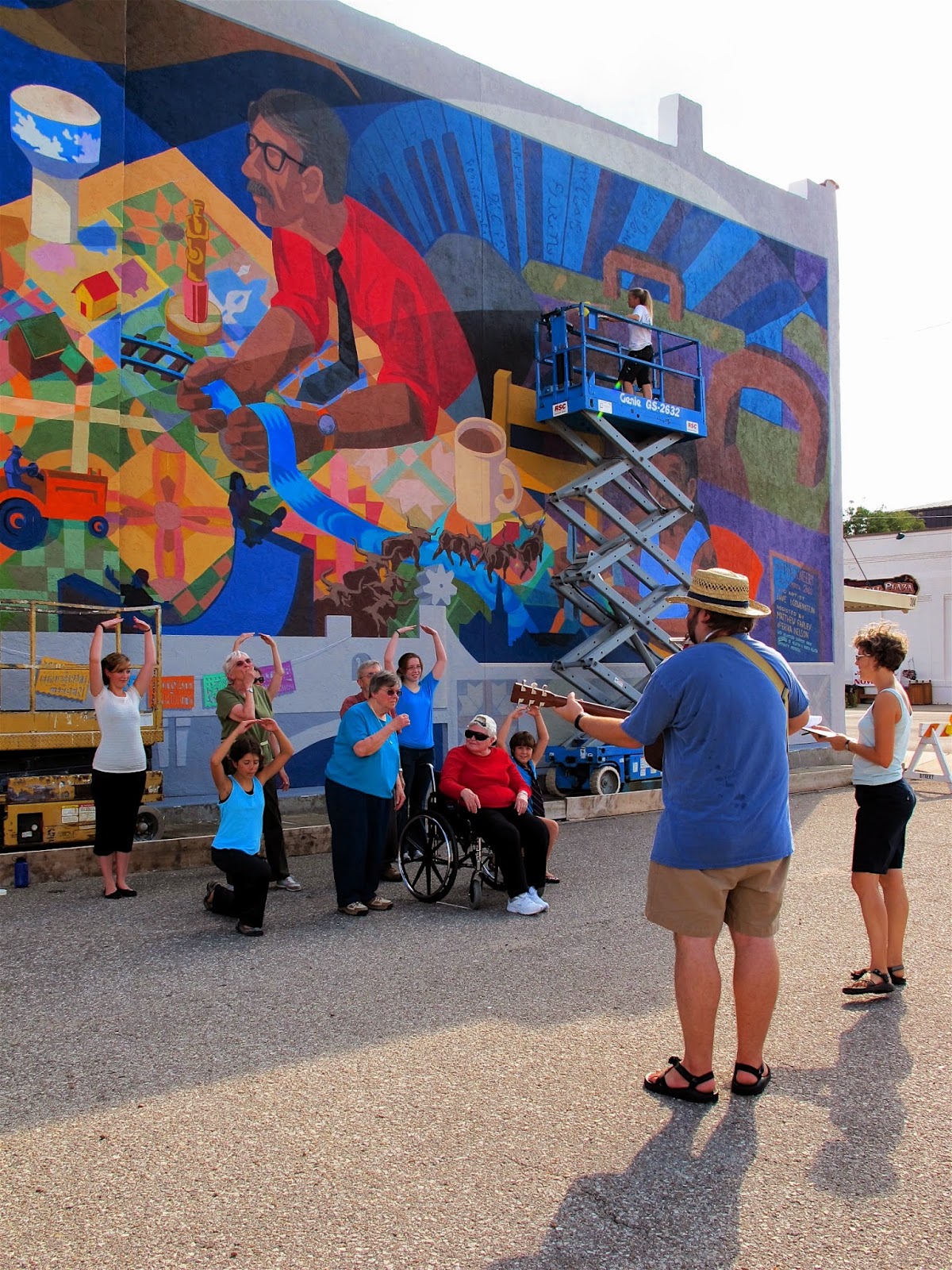
Sara Dick (far right) leads citizens of Newton, Kansas, in a dance rehearsal in front of Dave Loewenstein's "The Imagineers." Image: courtesy of the artist
DL: You know they are. When you take creativity out of the 'Art' context, everyone's included. And because you engage people in the place where they live, the possibilities increase. You're not bound by the walls and strictures of a gallery or a scene, but you still want to do the most sophisticated work you can, given the situation and the resources. You don't want to dumb down the art; you want to keep the bar high. People respond best to a worthy challenge.
TK: "The Mural Project: Dave Loewenstein" is featured on the front page of the Mid-America Arts Alliance's website. What's the story?
DL: First of all, working with people who can make things happen and understand what you're doing is amazing. Realistic budgets and schedules, and art students as helpers! And documentation! Film maker Nick Ward documented the two murals we did this year in Kansas and Oklahoma. The documentary aspect was the most challenging art I've ever done, working on so many levels and with so many variables. Everything was up for grabs! How did it happen? A call from Mary McCabe a couple of years ago.
______
Mary Kennedy McCabe is the executive director for Mid-America Arts Alliance, founded in 1972 and based in Kansas City, Missouri. Mid-America Arts Alliance — in partnership with the state art agencies of Arkansas, Kansas, Missouri, Nebraska, Oklahoma, and Texas — supports and administers a wide range of performances, exhibitions and educational programs connecting with over one million Midwesterners annually.
"I learned about Dave's work in 2008 — the Great Wall of Topeka mural," says McCabe. "I invited him to speak about his work to the (M-AAA) staff, and after the presentation, we floated the idea of a mural project. This year, we got the funding to do a pilot program in Tonkawa, Oklahoma, and Newton, Kansas."

Dave Loewenstein, "Listening Back, Dreaming Forward," in Tonkawa, Oklahoma, completed in May 2010. Image: courtesy of the artist
The pilot mural project — a partnership with the Kansas Arts Commission and the Oklahoma Arts Council — had stringent qualifications. Towns had to apply for the murals, and each of the finalist communities was visited by a selection committee, which included Loewenstein, before the murals were awarded. "It was a detailed set-up process. We wanted to make sure that each community knew that Dave's mural was not going to be your standard chamber-of-commerce production," McCabe says. "We had to be confident that that the community was ready, willing, and able to fully participate in the project."McCabe prizes the positive results of Loewenstein's work. "At M-AAA, we hold a core value that cultural expression is intrinsic to human beings. Our mission is to help people and communities express themselves," she says. "With Dave, the real work of art is the process that occurs. To me, the mural is an artifact of that process." The M-AAA's collaboration with Loewenstein is a step-by-step affair, contingent primarily on funding. A project in Missouri is in the works for 2011.

DL: I'm more of an activist in my printmaking and stencils, but it gets into the murals too. A lot of artists doing public work steer clear of the politics, but I'm responding to the conversations I have with the locals. If a political issue rises to the surface, let's put it in the mural. We're not going to pussy-foot around this stuff. I started using stencils in 1991 at KU. Activism was in the air, people protesting everywhere. Stencils were an immediate, efficient, and cheap method of communication, and I could put an image or a message anywhere — on the street, buildings, cars, placards, or on a nice sheet of paper. I went crazy with stencils on the KU campus. It opened a whole new thing for me. I liked the anonymity, the different audience. Activism, for me, is a natural response to a certain kind of situation. Maybe I'm just working things out for myself. I deal with my concerns by making something, and sometimes I make the politics obvious. I have lots of ideas and they need to be realized in different ways. A good artist finds the right outlet.
TK: Are you a Banksy fan?
DL: Some of it. I'm not so sure he's one guy anymore. My dream would be that he's 50 people, not necessarily aware of each other. That's my kind of anarchism.

Dave Loewenstein, detail of "Nickels and Dimes," 22" x 210". Image: courtesy of the artist
TK: Works like Nickels and Dimes are part of an ongoing series of large-scale drawings which you describe as 'Wordless Short Stories.' They look like cartoon strips without speech balloons.DL: They started with looking out the window of a bar or coffee shop, watching the street characters. Like overhearing, but overseeing. I thought if I eliminated words and let viewers fill in the narrative, they'd have an experience somewhat similar to my overseeing. Like storyboards. In fact, they opened a whole new thing for me — that was the first time I thought about working with film makers. Ultimately, they are a selfish pleasure: not about collaboration, not about politics, just daydreaming scenarios. They're hard work, but a joy to make.
TK: Your role in the mural process is, in large part, that of teacher. Now that role is official: this spring, you're leading a class at Washburn University in Topeka.
DL: That's another connection from the Great Wall in Topeka. One of the mural assistants was a student at Washburn and put me in touch with Glenda Taylor, the chair of the art department. I proposed a class, "Roots and Practices," and she liked it. It runs January through May 2011, about 18 students. There's a significant learning curve, so half of the class will be reading, lectures, and guest speakers. For the second half, we'll pick a few sites around town and the students will develop specific public art proposals. For the first year, it's proposals only — we'll exhibit those at the end of the semester. I'll teach the class my way: we'll meet off-site, make food, and do our work in non-traditional settings.
.JPG)
Dave Loewenstein's 411 Studio in Lawrence, Kansas.
DL: The Percolator is a dream come true. We're not a gallery — we don't want to book fancy art, cater to hipsters, and go after money. It's not just another place to hang your stuff. Generating new ideas is what we're about, not exalting personalities. The Percolator is a place where artists collaborate to expand on what they do. Percolate it! Lawrence deserves a credible alternative art space. We want to surprise people at every turn — feasts, parades, art shows … everything!